Disclosure: This comparison currently contains no affiliate links. If affiliate links are added later, we may earn a commission at no additional cost to you. Our editorial judgments remain independent.
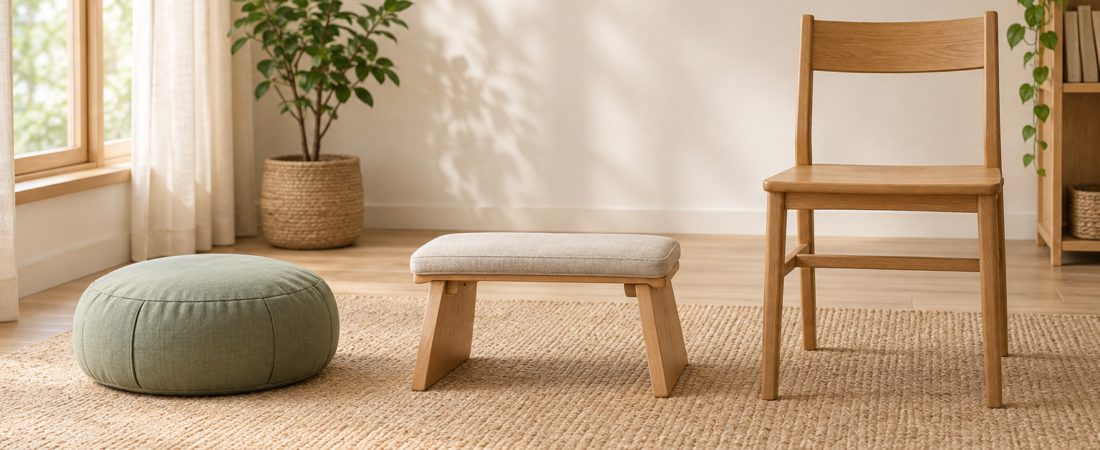
A meditation cushion, kneeling bench, and ordinary chair can all support a seated practice. The most beginner-friendly choice is not the one that looks most traditional. It is the option that lets you settle into a stable position, breathe naturally, and get up without forcing your body.
This guide compares the three options by fit, stability, mobility demands, storage, and cost. It is an educational buying guide, not a medical recommendation, and we have not ranked individual brands or claimed first-hand product testing.
The Short Answer
| Option | May suit beginners who | Main limitation |
|---|---|---|
| Meditation cushion | Can sit near the floor comfortably and want flexible leg positions | Requires getting down to and up from the floor |
| Kneeling bench | Prefer a kneeling position and want a firm, compact support | Places the lower legs on the floor and demands careful sizing |
| Chair | Want easier access, foot support, and familiar stability | A deep, soft, wheeled, or incorrectly sized chair may be distracting |
If you are unsure, begin with a stable chair or test cushion height with folded blankets. You do not need special equipment to try a brief breathing or attention practice.
Option 1: Meditation Cushion
A round, crescent, or rectangular cushion raises the sitting surface while keeping you close to the floor. It allows several cross-legged or supported kneeling positions, depending on the cushion’s shape and your comfort.
Potential advantages
- Flexible leg placement.
- Compact storage and easy repositioning.
- Many choices of height, shape, filling, and firmness.
- Some models allow filling to be removed or added.
Limitations to consider
Floor sitting still requires hip, knee, and ankle movement, and standing up from the floor may be difficult for some people. A cushion that is too low may compress more than expected; one that is too high or narrow may feel unstable. Appearance alone tells you very little about fit.
Before buying, use folded blankets to test approximate height. Our separate meditation cushion buying guide explains shapes, fillings, dimensions, cleaning, and return policies in more detail.
Option 2: Kneeling Meditation Bench
A meditation bench supports the pelvis above the lower legs in a kneeling position. Some benches have a fixed angle, while others use rounded or folding legs. Small differences in height and tilt can substantially change how the bench feels.
Potential advantages
- A firm, repeatable sitting surface.
- Compact size compared with most chairs.
- No need to arrange the legs in a cross-legged position.
Limitations to consider
A bench is not automatically easier on the knees. The lower legs remain on the floor, so pressure, ankle position, and the surface underneath matter. A bench that rocks, slips, pinches, or is too low should not be used. Folding hardware should lock securely, and the stated dimensions should be checked before purchase.
Do not improvise with a household stool placed over the legs. A meditation bench is designed for a specific direction and load; using an unsuitable object can create a tipping or collapse risk.
Option 3: Chair
A chair is a valid seated-practice option, not a lesser substitute. It may be the simplest starting point for people who prefer not to sit on the floor or who want their feet supported.
Potential advantages
- Easier entry and exit for many people.
- Feet can rest on the floor or a stable foot support.
- No specialized purchase may be necessary.
- Useful for short practices at home, work, or while traveling.
Limitations to consider
Very soft seats can make position changes harder to notice. Deep seats may prevent the feet from being supported, and a seat that is too high or low may feel awkward. Avoid rolling, swiveling, folding, or unstable chairs unless they can be secured appropriately. A firm dining-style chair often provides a clearer test than a sofa or lounge chair.
Six Questions to Decide Between Them
- Can you get down to and up from the floor comfortably? If not, a chair is usually the more practical starting point.
- Which leg position feels natural? Do not force a cross-legged or kneeling posture because it appears traditional.
- Do you need adjustable height? Removable cushion filling offers more adjustment than most fixed benches.
- How stable is the floor surface? Smooth flooring may require a nonslip mat under a cushion or bench.
- Will you move or store the support? Compare total weight, handles, folding parts, and storage space.
- Can you return it? Fit is difficult to judge online, so the return window and fees matter.
A Ten-Minute Comparison Test at Home
You can learn a great deal before purchasing anything. Test a stable chair and a firm stack of folded blankets on a nonslip surface. Do not try to build a homemade kneeling bench.
- Sit on the chair for two or three minutes with both feet supported.
- Notice whether you can remain upright without gripping or rigidly holding yourself.
- If floor sitting is already comfortable, test two or three blanket heights briefly.
- Check whether you can change position and stand up without difficulty.
- Write down the approximate height, firmness, and width that felt most stable.
Stop if you notice sharp pain, numbness, dizziness, weakness, breathing difficulty, or worsening symptoms. If a health condition, pregnancy, surgery, injury, balance concern, or medication affects safe movement, ask a qualified healthcare professional for individualized guidance.
What Is Worth Paying For?
- Dimensions that match your home test.
- A stable base and nonslip contact with the floor.
- Strong seams, secure joints, or locking hardware.
- A removable, washable cover when relevant.
- Clear material, care, weight, and return information.
Vague promises about correcting posture, removing pain, improving circulation, or producing spiritual results are not useful buying criteria. Higher price does not establish better fit or better health outcomes.
Frequently Asked Questions
Is a meditation bench better than a cushion for knee discomfort?
Not necessarily. Both options involve floor-level positions and can load the legs differently. A product comparison cannot identify the cause of discomfort or prescribe a suitable posture.
Do I need to sit on the edge of a chair?
No single position is required. Choose a stable placement that allows your feet to remain supported and does not make you feel as though you may slide or fall.
Can I use a sofa instead?
You can practice attention or natural breathing in many positions, but a deep, soft sofa may make a consistent upright position harder to repeat. A stable chair is easier to evaluate.
Which option is best for travel?
The lightest option is not always necessary: a destination chair may eliminate the need to carry equipment. If you do carry a cushion or folding bench, check weight, packed dimensions, and hardware security.
A Practical Decision Rule
Start with the option you can test safely and access easily. Choose a chair when floor access is inconvenient, a cushion when you already tolerate floor sitting and want flexible positioning, or a properly sized bench when kneeling is familiar and comfortable. Reassess if your condition or practice changes.
For a practice you can try without special equipment, see Seated Qigong for Beginners and Qigong Breathing for Beginners.
Source and Safety Context
The U.S. National Center for Complementary and Integrative Health notes that meditation and mindfulness practices are generally considered to have few risks, but research on potentially harmful effects remains limited. Product choice should therefore be framed as a comfort and access decision rather than a treatment claim. See Meditation and Mindfulness: Effectiveness and Safety.
Medical Disclaimer
This article is for general educational purposes only. It is not medical advice and is not a substitute for diagnosis, treatment, or guidance from a qualified healthcare professional.
Leave a Reply