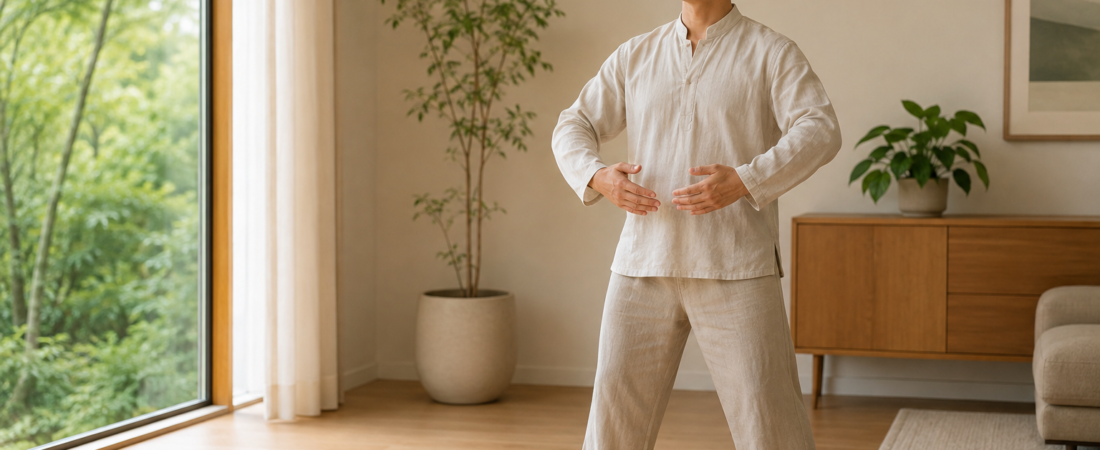
Qigong is a traditional Chinese practice that combines posture or gentle movement, breathing, and focused attention. Many styles exist, and no single routine represents all qigong. For a beginner, the most useful starting point is often simple: stand or sit comfortably, move within an easy range, and let the breath stay quiet and natural.
This guide offers a short practice for generally healthy adults. It is intended as mindful movement and relaxation—not as a treatment for a medical condition or a replacement for professional care.
What Is Qigong?
The word qigong is commonly used for a broad family of Chinese practices involving regulation of the body, breath, and attention. Some forms are dynamic and use smooth whole-body movements. Others are mostly still and emphasize posture, breathing, or meditation.
Traditional explanations may refer to qi, often translated as vital energy. That traditional framework is part of qigong’s cultural history, but it should not automatically be treated as a scientifically established mechanism. Modern readers can approach beginner qigong as a form of gentle, attentive movement without making claims that it cures disease or controls an invisible force.
What Does the Research Say?
The U.S. National Center for Complementary and Integrative Health (NCCIH) reports that qigong has been studied for pain, balance, quality of life, and symptoms associated with several health conditions. Some findings are encouraging, but study quality, program length, and results vary. For many specific conditions, the evidence remains limited or uncertain.
That means qigong can be discussed as a potentially useful form of gentle activity, not as a guaranteed treatment. It should never be used to postpone evaluation of a medical problem or to replace prescribed care.
Safety Check Before You Begin
Qigong generally appears to be a low-risk activity when movements are comfortable and appropriate for the individual. Minor soreness, muscle discomfort, or headache has been reported in some studies. Falls or strain are also possible if balance is challenged or movements are forced.
Ask a qualified healthcare professional before beginning if you are pregnant, recovering from surgery or injury, have significant balance problems, fainting episodes, uncontrolled pain, heart or lung disease, or another condition that may affect safe movement or breathing. Use a stable chair for support if standing is uncertain.
Stop the practice if you develop chest pain, severe shortness of breath, faintness, new weakness, sharp pain, or symptoms that concern you. Seek urgent medical help when symptoms may represent an emergency.
How Should Qigong Breathing Feel?
Begin with ordinary breathing. You do not need to take the deepest possible breath, hold your breath, or force the abdomen outward. A comfortable breath should allow you to keep the face, throat, and shoulders relaxed.
- Breathe through the nose if that is comfortable; use the mouth when needed.
- Let the exhalation finish without pushing.
- Avoid rapid breathing or long breath holds.
- If focusing on breathing makes you anxious or dizzy, return to normal breathing and stop.
The goal is not to achieve a special sensation. It is simply to coordinate gentle movement with comfortable attention.
A Gentle 10-Minute Beginner Practice
Choose a clear space and wear clothing that allows easy movement. Practice barefoot only if the floor is safe and your balance is steady; otherwise wear supportive footwear. You may perform the entire routine seated.
Minutes 1–2: Arrive and Settle
Stand with the feet about hip-width apart, knees soft rather than locked. If seated, place both feet on the floor. Allow the arms to hang comfortably. Notice contact with the floor or chair and take several ordinary breaths.
Minutes 3–4: Open and Close
Hold the hands in front of the lower ribs as if resting around a large ball. As you breathe in comfortably, let the hands drift a few inches apart. As you breathe out, let them return. Keep the elbows heavy and the shoulders easy. Repeat slowly without trying to synchronize perfectly.
Minutes 5–6: Gentle Weight Shift
Keeping both feet on the floor, shift a small amount of weight toward the right foot and return to center. Then shift toward the left. Make the movement smaller than you think necessary. Seated practitioners can gently shift the torso a little from side to side while keeping both sitting bones supported.
Minutes 7–8: Raise and Lower the Hands
Let the hands float forward to a comfortable height—no higher than the shoulders—and then lower them. The palms can face down or toward each other. Breathe naturally. Avoid lifting the shoulders or reaching beyond a comfortable range.
Minutes 9–10: Return to Stillness
Rest the hands by your sides or on your thighs. Notice your breathing without changing it. Observe whether you feel calmer, unchanged, tired, or uncomfortable. All of these responses are information. Finish slowly, and hold a chair or wall before walking if you feel unsteady.
Common Beginner Mistakes
- Trying to breathe too deeply: bigger breaths are not automatically better and may cause light-headedness.
- Locking the knees: keep the legs comfortably supported and avoid rigid posture.
- Chasing perfect coordination: let movement and breath meet gradually rather than forcing a count.
- Practicing through pain: reduce the range, sit down, or stop.
- Expecting immediate health results: one short session cannot diagnose, prevent, or cure a condition.
How Often Should a Beginner Practice?
There is no universal schedule. Five to ten comfortable minutes a few times per week may be a practical starting point. Consistency matters more than intensity. If you become sore, unusually fatigued, dizzy, or short of breath, reduce the duration or stop and seek appropriate advice.
Frequently Asked Questions
Is qigong the same as tai chi?
Not exactly. Tai chi developed from a martial art and is often practiced today for health and rehabilitation. When practiced for health, it may be considered one form within the wider family of qigong-style mind-body exercises.
Do I need an instructor?
A simple routine can be explored independently, but a careful instructor can help adapt posture and movement. Qigong instruction is not regulated to one national standard in the United States, so ask about training, experience, and how the instructor handles health limitations.
Can I practice while seated?
Yes. Many gentle arm movements and attention exercises can be adapted to a stable chair. Keep both feet supported and choose a chair without wheels.
Continue Learning
For cultural background, read What Is Yang Sheng? You can also explore our beginner self-massage guide or return to the Start Here learning path.
Sources and Further Reading
- NCCIH: Qigong—What You Need To Know
- NCCIH: Traditional Chinese Medicine—What You Need To Know
- NHS: Breathing Exercises for Stress
Medical Disclaimer
This article is for general educational purposes only. It is not medical advice and is not a substitute for diagnosis, treatment, or guidance from a qualified healthcare professional.
Leave a Reply